
Echoes May VD of the Month - Suss-Counting Sunsets
By John Diliberto
5/1/2026
 It’s rare you hear a band play so few notes and get such a big sound. I’m not talking orchestral big or arena rock big. I’m talking Grand Canyon big, high plains big – a sound that washes through expanses of open landscapes, making itself part of that environment like dusk descending. Because it is part of the environment, that’s also why it is so intimate and personal. It envelopes you. That is the sound of SUSS.
We’ve been following the ambient country band SUSS from their beginning in 2016. The trio includes guitarist Pat Irwin, who was a member of The B-52s and The Raybeats, and has scored several movies and TV shows including Nurse Jackie, the Dexter sequel and prequel, and on a different note, SpongeBob SquarePants. Guitarist Bob Holmes was a member of Rubber Rodeo and plays in the psychedelic ambient group, numün. Pedal steel guitarist Jonathan Gregg doesn’t have as long of a CV, but it’s his pedal steel guitar that weaves the band together.
SUSS had a CD of the Month in March of 2025 with Nanocluster 3, their collaboration with the duo, Immersion. Counting Sunsets is nothing like that. There are no drums or rhythms you can nod your head to, let alone dance, and barely any synthesizers. Like most SUSS recordings, it’s an album of immersion more than movement.
Each track is just called “Sunset” I-X. The opening, “Sunset I,” seems hymnal. Although there are no singers or synths, there is a sound like voices in mourning, merging with long pedal steel moans. A piano plucks out distant notes and slowly, a pensive strummed guitar emerges, equally solemn. It is a contemplative opening to an album that is in awe of nature and in the knowledge that we have fewer sunsets remaining every day of our lives. It may be the most Enoesque track on the album.
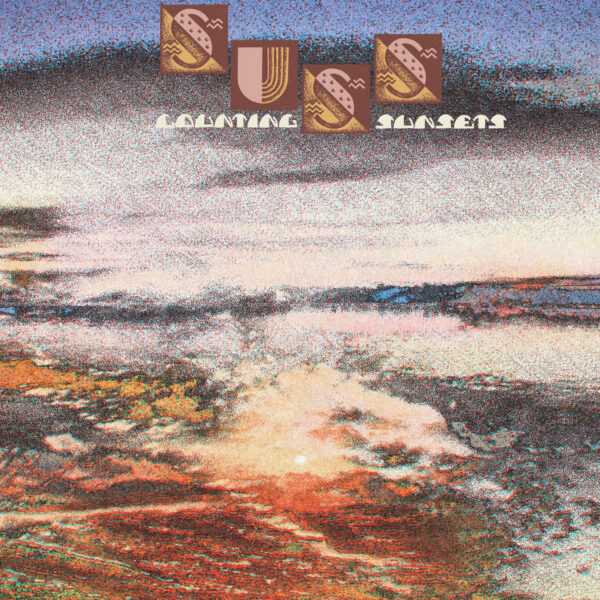 SUSS play with space on some tracks like “Sunset III,” with pedal steel sliding back and forth in stereo while a guitar whines in the central distance. It feels like you’re being carried aloft, the world fading beneath you as you traverse the countryside. For all its technology and spaciness, this is not urban music, this is music for the open west, which is one of the reasons I prefer the term Ambient Americana to Ambient Country. It’s not about Americana music per se, it’s about the American myths and vistas of the west. This is the soundtrack that SUSS creates.
“Sunset V” is a swirl of e-bow guitar recalling Robert Fripp’s looping works, with one guitar all fuzzed out while the other is a long slowly oscillating siren sustain. Holmes plays a simple arpeggio that he seems to drop in at random, but appropriate moments, while Gregg lances them in pedal steel slides.
There is a lot of drift on Counting Sunsets, but “Sunset VI” may be the most tuneful song on the album. It opens with a plaintive solo lead from Gregg, bathed in delay, with Holmes chiming in with sparely strummed zither. Irwin plucks a slow arpeggio on what I suspect is a Telecaster guitar, but soon switches to a swooning e-bow that is embraced by Gregg’s pedal steel.
The most country vibe of the album is on “Sunset VII” where Holmes is playing lonesome-trail harmonica, but that’s about as Nashville as it gets. Irwin and Gregg interweave guitar and steel sliding lines descending from outer space. There is a reason they’ve been nicknamed Dark Side of the Moonshine.
SUSS spend most of their time on the consonant side of the line, but “Sunset IX,” the penultimate track, edges into much more abstract and angst-driven terrain, with a one-note stuttering organ-like pattern, as guitars acoustic, electric and slide, play out as if they are trying to converge on something but don’t quite hit it, ending in a confusion of directions.
There is not a lot of conventional melody on Counting Sunsets. The occasional arpeggio guitar like the one on “Sunset VII” is about as close as you get to it until the final track, “Sunset X.” An acoustic guitar is strummed, as if laying the backing for a singer. Piano enters in slender counterpoint and Gregg, as ever, ties it together. There’s also a shimmering background effect, like a fluttered whistle that adds tension. That and the stammering synthesizer on “Sunset II” are examples of the tiny details buried in the deep horizon of Counting Sunsets.
Looking back on this review, I keep seeing spare, simple, slow, as adjectives, but rarely do those words associate with a music of vastness. Counting Sunsets manages to create that expanse, while also being a music of the quietest intimacy.
Hear SUSS and Immersion Live on Echoes
Hear our interview with SUSS and Immersion
THE END
You’re a good writer John